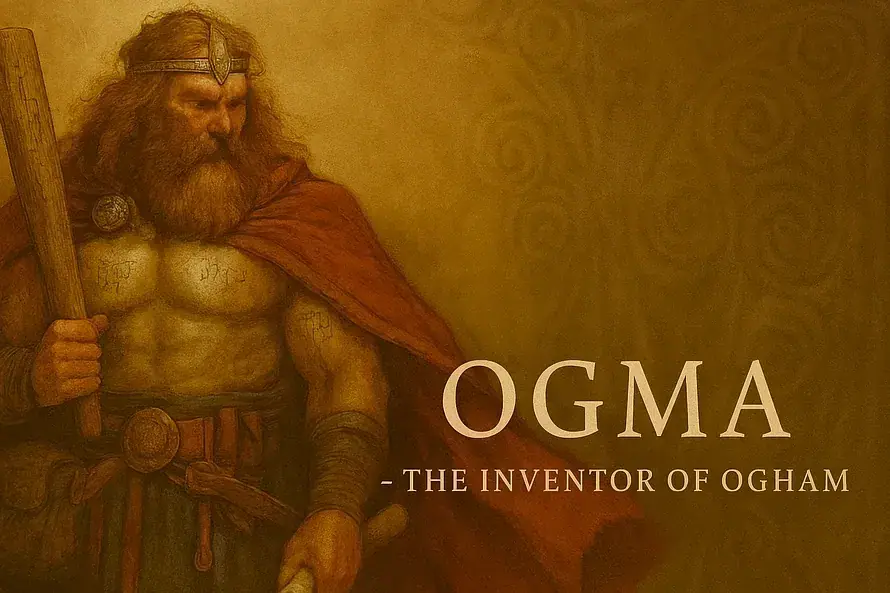
Every writing system has an origin story. The Mesopotamians credited the gods with cuneiform. The Norse said Odin hung upside down on Yggdrasil for nine nights to discover the runes. In Ireland, the invention of Ogham is attributed to Ogma — a god of eloquence, a champion warrior, and one of the most fascinating figures in the Irish mythological tradition.
Who Was Ogma?
Ogma (Oghma in Old Irish, sometimes Ogmios in continental Celtic tradition) is a member of the Tuatha Dé Danann — the divine race who inhabited Ireland before the coming of the Gaels in Irish mythology. He is typically described as the god of eloquence and of binding, and as a champion warrior second only to the Dagda in physical strength.
The medieval Irish text Cath Maige Tuired (The Second Battle of Mag Tuired) portrays Ogma as a battle-hardened figure who captures the magical sword of the Fomorian king Tethra and fights alongside the Tuatha Dé in their war against the Fomorians.
He is also credited with the invention of the Ogham script.
The Etymology
The name Ogma is believed to derive from a Proto-Celtic root meaning “to cut” or “to score” — a direct reference to the way Ogham letters are carved: scored into stone or wood with a series of notches and strokes. If this etymology is correct, the god’s name encodes the script’s defining characteristic.
The connection to speech and eloquence is equally significant. In Celtic tradition, eloquence was not merely a social grace but a kind of power. The ability to speak well, to argue convincingly, to compose poetry — these were understood as divine gifts. An alphabet, in this context, is not merely a practical tool for recording information. It is the solidification of speech into matter.
Ogma and Ogmios
The continental Celtic deity Ogmios, described by the Roman writer Lucian in the 2nd century CE, is depicted as an old man leading a crowd of men by thin golden chains attached to their ears — chains leading back to his tongue. The image represents the power of eloquence to bind and lead. Men follow willingly where the gifted speaker leads.
Whether Ogma and Ogmios are the same deity is debated by scholars. What is clear is that the concept of a divine figure who embodies speech, writing, and the power of language was present across the Celtic world.
The Proof of Ingenuity
Medieval Irish sources say Ogma invented Ogham as a proof of ingenuity — a demonstration of intellectual capability. The first Ogham inscription, according to tradition, conveyed a warning: seven strokes of birch (beith), communicating that a woman would be carried away to the Otherworld unless she was protected by birch.
Seven strokes. A complete message. The alphabet demonstrated its own power in its first use.
What the Mythology Tells Us
The attribution of Ogham to a divine inventor tells us something important: the people who used this script understood it as more than a practical notation system. Like the runes attributed to Odin, Ogham carried the weight of sacred origin. To carve Ogham was, in some sense, to participate in a tradition that traced back to the gods themselves.
Learn more about the history and origins of Ogham or explore the complete alphabet.