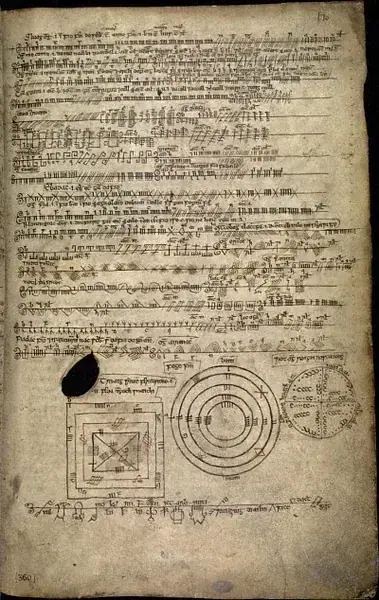
Most people think of Ogham as a monument script — those vertical inscriptions on standing stones reading “X, son of Y.” And that is accurate for the early period. But by the medieval era, Irish scholars had taken Ogham somewhere unexpected: they were using it as a cryptographic tool.
The Scholarly Primers
Two medieval texts are essential here: Auraicept na nÉces (The Scholar’s Primer) and the Book of Ballymote. Both contain detailed descriptions of cipher Ogham systems — ways of scrambling or transforming the standard Ogham alphabet to create encoded messages that only the initiated could read.
The Auraicept alone describes over 100 variant Ogham systems. Some are simple substitutions. Others involve rotating the alphabet, reversing stroke directions, or using entirely different referent systems (tree names, colours, birds, river names) in place of the standard letters.
Codex Sangallensis 904
One of the most important physical examples of cipher Ogham in action comes from the Codex Sangallensis 904, a manuscript held in St Gallen, Switzerland. This manuscript contains Irish marginalia — notes added by Irish monks — including examples of Ogham script used in what appear to be encoded messages.
The presence of Irish Ogham in a Swiss monastery tells its own story: Irish monks carried the script with them as they travelled across Europe, and they used it in contexts that go far beyond simple transliteration. To write in Ogham in a foreign monastery was to write in a script that almost no one around you could read.
How the Ciphers Worked
The simplest cipher systems worked by substitution: replace each Ogham letter with the corresponding letter from a different, agreed-upon sequence. More complex systems used positional encoding — the position of a mark within a line conveyed different information than in standard Ogham.
“Ogham of the hand” (ogham láimhe) took this even further: a person could sign messages using touches to different parts of their own body, with fingers representing different letter groups. It was, essentially, a haptic cipher — a secret language of gesture.
Why Does This Matter?
It matters because it reveals Ogham’s cultural flexibility. A script that began as a simple stone-carving notation became, over centuries, a vehicle for scholarship, secrecy, and display of learning. Medieval Irish monks used it to show off, to encode private communications, and — possibly — to keep knowledge from those they considered unworthy of it.
The next time you see a simple standing stone inscription, remember: the script carved there went on to become one of the most elaborate cipher systems in medieval European scholarship.
Explore the Ogham alphabet in full or try our Ogham translator.