Celtic symbols are among the most widely recognised in the world. The spiralling triskelion appears on the Irish passport. Celtic knotwork decorates everything from medieval manuscripts to modern tattoos. The Claddagh ring is exchanged at weddings on every continent. Yet the meanings behind these symbols — and the cultures that produced them — are often misunderstood.
This guide covers the major Celtic symbols, what they actually represent, and where they came from. It ends with Ogham, the one Celtic symbol that is also a complete writing system — and the only one that has survived in its original carved form on hundreds of standing stones still visible across Ireland, Scotland, Wales, and England today.
What Makes a Symbol “Celtic”?
The Celts were not a single unified people but a broad family of cultures sharing related languages and artistic traditions, spread across much of Iron Age Europe from around 800 BCE. The symbols we call Celtic today come from several distinct sources:
- La Tène art — the decorative tradition of Iron Age Celtic Europe, characterised by flowing spirals and interlaced designs
- Early Christian Ireland — the monastic tradition that combined Celtic decorative art with Christian iconography
- Medieval manuscript art — illuminated books like the Book of Kells that fused Celtic and Christian visual traditions
- Modern revival — the Celtic Revival of the 19th and early 20th centuries, which popularised and sometimes invented Celtic symbolism
Many symbols described online as “ancient Celtic” were in fact developed or codified during the medieval Christian period, and some are entirely modern inventions. Knowing the difference adds real depth to any engagement with Celtic heritage.
The Major Celtic Symbols and Their Meanings
The Triskelion (Triskele)
The triskelion — three interlocked spirals radiating from a centre point — is one of the oldest Celtic symbols of all. The most famous example is carved into the entrance stone at Newgrange, a passage tomb in Co. Meath built around 3200 BCE, predating the Celts themselves. In Celtic culture it was later associated with the concept of triple power: land, sea, and sky; past, present, and future; birth, death, and rebirth. It remains the symbol of the Irish state and appears on the coat of arms of the Isle of Man.
The Celtic Knot
Celtic knotwork — interlaced patterns with no clear beginning or end — developed primarily in early Christian Ireland and Northumbria between roughly the 7th and 10th centuries CE. Far from being ancient pagan symbols, knotwork designs were largely created by monastic artists decorating Gospel manuscripts and stone crosses. The continuous unbroken line is associated with eternity and the interconnectedness of life, but these meanings were largely assigned retrospectively rather than documented historically.
The Triquetra (Trinity Knot)
The triquetra — three interlocking arcs forming a single continuous, unbroken shape — is one of the most recognised Celtic symbols in its own right, distinct from general knotwork. It appears on Celtic stonework as early as the 7th century CE and was later adopted widely in Christian art to represent the Holy Trinity: Father, Son, and Holy Spirit. Pre-Christian interpretations, largely speculative, connect it to other Celtic “rule of three” motifs such as maiden-mother-crone or land-sea-sky. Today it is one of the most requested designs for Celtic jewellery and tattoos, often paired with a circle representing eternity.
Awen
Awen — three converging rays or lines, often shown radiating from three points — is a symbol associated with poetic and creative inspiration in Welsh and, later, Neo-Druidic tradition. Unlike the triskelion or triquetra, Awen has no confirmed ancient origin; it was popularised by the 18th-century Welsh scholar Iolo Morganwg as part of his (partly invented) Bardic tradition, and it remains central to modern Druidry. It’s a useful example of how some “ancient” Celtic symbols are, in fact, comparatively recent revivals.
The Spiral
Simple and triple spirals appear throughout Neolithic Ireland (Newgrange, Knowth, Dowth) and later in La Tène Celtic art. In Celtic culture, the spiral is generally associated with growth, expansion, and the cyclical nature of life — the movement from inner to outer self, or from death to rebirth. Single spirals appear commonly on Irish jewellery and stonework.
The Celtic Cross
The high crosses of early medieval Ireland — standing stone crosses elaborately carved with biblical scenes and knotwork — are among the most striking survivals of Celtic Christian art. The distinctive circle intersecting the crossbar is often described as a fusion of the Christian cross with a pre-Christian sun symbol, though some scholars argue the circle was primarily a structural device to support the heavy stone arms. Whatever its origin, the Celtic cross has become one of the most enduring symbols of Irish identity.
The Claddagh
The Claddagh — two hands holding a crowned heart — originated in the Claddagh fishing village outside Galway city, probably in the 17th century. Despite its relatively recent origin, it has become one of the most recognised Irish symbols worldwide. The three elements represent love (the heart), friendship (the hands), and loyalty (the crown). How it is worn — which hand, which direction the heart points — traditionally signals the wearer’s relationship status.
The Shamrock
The three-leafed shamrock is associated with St Patrick, who is said to have used it to explain the Christian Trinity to the Irish. Whether the story is historical is debatable, but the shamrock was already a recognised Irish symbol by the 17th century. It should not be confused with the four-leafed clover, which is a separate good-luck symbol with no particular Celtic heritage.
The Tree of Life
The crann bethadh (tree of life) in Irish tradition represented the sacred trees believed to stand at the centre of each Irish territory. Cutting down an enemy’s sacred tree was a serious act of war. The imagery of a tree with roots and branches mirroring each other appears across many cultures but has deep roots in Celtic cosmology, connecting the underworld, the earthly realm, and the heavens.
Brigid’s Cross
Woven from rushes into a four-armed equilateral cross with a woven square at the centre, Brigid’s Cross is traditionally made on St Brigid’s Day (1 February) and hung over doorways for protection through the year. It carries the name of Brigid — both a pre-Christian goddess of fire, poetry, and healing, and the Christian saint who absorbed many of her attributes — making it one of the clearest examples of pagan and Christian symbolism merging in Irish tradition.
Ogham — The Celtic Symbol That Is Also an Alphabet
Every symbol above is a visual motif — a shape carrying meaning. Ogham is something fundamentally different. It is the only Celtic symbol system that is also a complete, functional writing system.
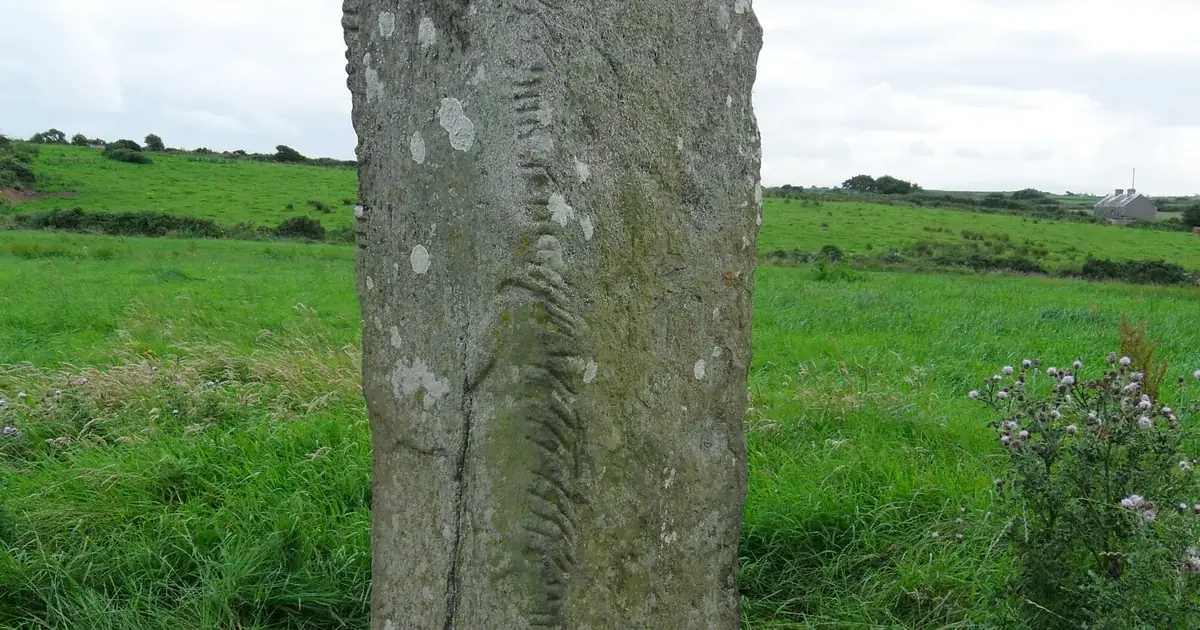
Developed in Ireland probably during the 4th century CE, Ogham consists of 25 characters, each formed by combinations of strokes and notches cut across a central stem line. On standing stones — of which over 400 survive — that stem line is the edge of the stone itself. The inscriptions are almost always memorial formulas: X son of Y, sometimes with a kin group name, carved to mark territory and commemorate the dead.
What makes Ogham unique among Celtic symbols is that it carries verifiable, decodable meaning. Where we can only interpret a spiral or a knot, we can read an Ogham inscription. LUGUDECCAS MAQI NETA-SEGAMONAS, carved on a stone at Ardmore in Co. Waterford, tells us a specific person’s name, their father’s name, and their tribal affiliation — a voice from 1,500 years ago that can still be heard.
Ogham also has tree associations that connect it directly to other Celtic symbolism. Each of the 25 letters bears a name derived from a tree or plant: Beith (birch), Luis (rowan), Fearn (alder), Sail (willow), and so on through to Idad (yew). These names link the script to the wider Celtic reverence for trees as sacred beings, and to the figure of the druid as someone who read meaning in the natural world. Ogham’s dual role as symbol and script is also why it’s a popular choice for Celtic tattoos — a single name or word carries both linguistic and symbolic weight in a way a triskelion or knot alone cannot.
Why Ogham Matters for Celtic Heritage
Ogham occupies a unique position in Celtic culture: it is simultaneously a symbol system, a writing system, and a historical record. The hundreds of carved stones still standing across the Irish and British landscape are not decorative — they are documents, each one a fragment of a real early medieval life.
For anyone exploring Celtic heritage through symbols, learning to recognise Ogham characters adds a layer that no other symbol can offer. You move from looking at a pattern to reading a language.
Frequently Asked Questions
What is the most common Celtic symbol? The triskelion and the Claddagh are probably the two most widely recognised — the triskelion as a national emblem of Ireland, and the Claddagh as a popular symbol of love and friendship worldwide.
What Celtic symbol means love? The Claddagh (heart, hands, and crown) is the classic Celtic symbol for love, friendship, and loyalty. The triquetra is also sometimes used to represent eternal love, particularly in wedding jewellery.
Is Ogham a Celtic symbol? Yes, but it’s also something more: a complete alphabet used to write Old Irish. Unlike the other symbols on this list, an Ogham inscription can be read letter by letter for a specific, decodable meaning rather than interpreted as a single motif.
Are all Celtic symbols ancient? No. Some, like the triskelion and spiral, predate the Celts themselves. Others, like the Celtic knot and triquetra, were largely developed by early Christian monastic artists. And some, like Awen, are 18th-century or later revivals presented as far older than they are.
Ready to explore further? Use our free Ogham translator to write your name or a word in the ancient Celtic script — or read the complete Ogham alphabet guide to learn each of the 25 letters, their tree names, and their sounds. You can also browse the stone database to see real Ogham inscriptions from across Ireland, Scotland, and Wales.